

Load capacity of suction cups when using a cellulose coating to protect the coating on coated glass: Performed with suction cups 388 from Pannkoke and Euro-Tech. A study by the Kiel University of Applied Sciences (carried out in the first half of 2003) under the direction of Professor Dr Michael Klausner
General information
The Euro-Tech-388 and Pannkoke-388-1998 suction cups were tested for slippage (= direction of pull parallel to the glass surface) with a cellulose coating. The tests were carried out as static tests on the same test facility as earlier test series (see Fig. 1). A dynamic test up to the tear-off point does not make sense, as the holding force already causes the suction cup to creep well below the tear-off point. This may be acceptable up to a certain magnitude in practical use.
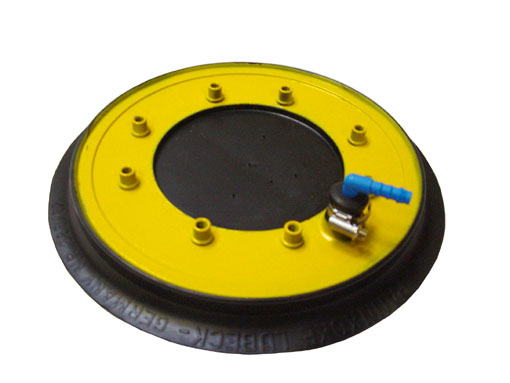
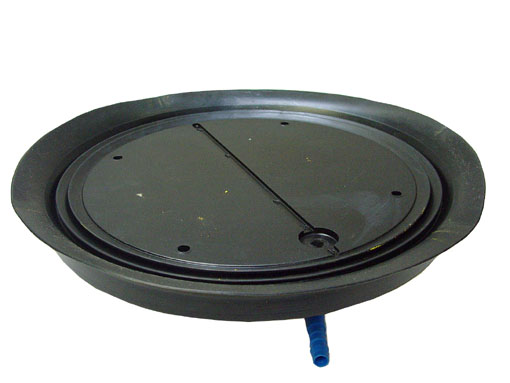
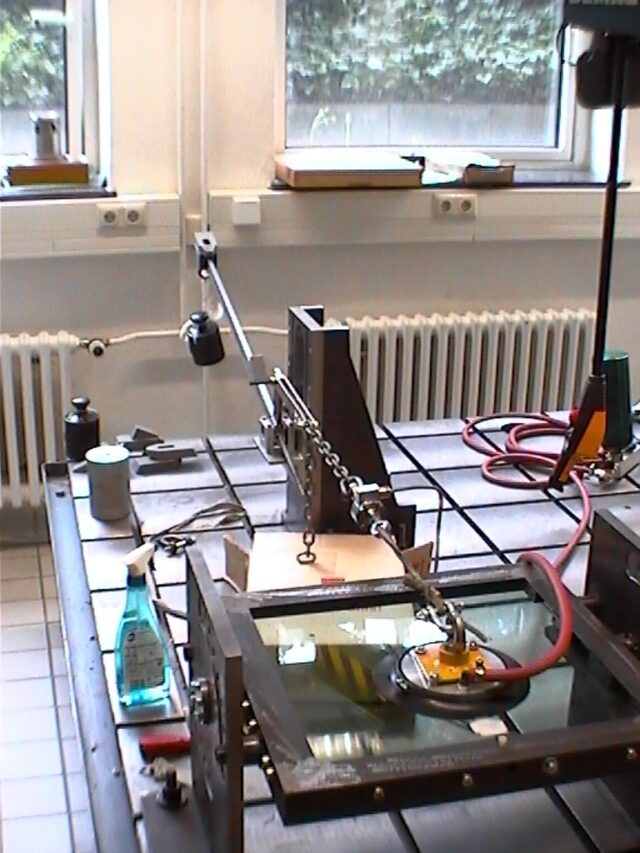
Carrying out the experiment
The Euro-Tech-388 suction cup (see Fig. 2) was tested first. The load was applied statically and increased in stages until significant creep occurred, after which the load was released and the creep stopped. The load was then increased again until creep occurred. The vacuum was always - 0.6 bar.
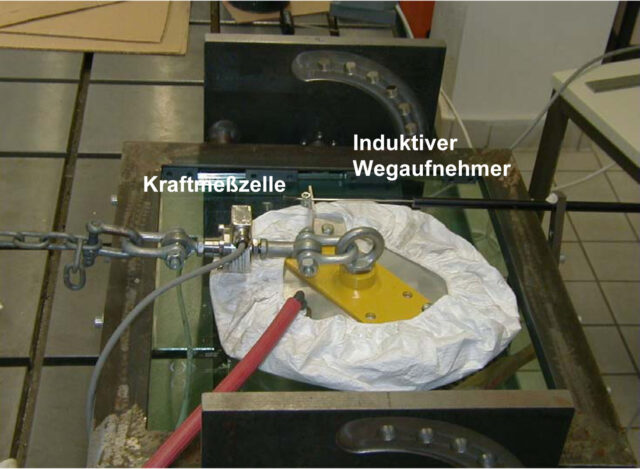
The table below shows the sliding speeds measured at the various load levels:
| Force [N] | Time for 1mm creepage distance [s] | Remark | Force [N] | Time for 1mm creepage distance [s] | Remark |
| 550 | 105 | 550 | >480 | Standstill | |
| 514 | >480 | Standstill | 528 | 120 | |
| 545 | 480 | 557 | 330 | ||
| 507 | >480 | Standstill | 478 | >480 | Standstill |
| 546 | 480 | 414 | >480 | Standstill | |
| 538 | >480 | Standstill | 511 | 240 | |
| 490 | >480 | Standstill | 551 | >480 | Standstill |
Table 1: Creep of the Euro-Tech suction cup similar to the 388 suction cup.
The creep speeds vary considerably, whereby the value of 511 N could be regarded as the limit value because a creep of 0.25 mm/min appears tolerable in view of the usual lifting and assembly times on the one hand and on the other hand a quasi standstill (creep speed < 0.17 mm/min) was predominantly recorded for this force.
In a second test run, the Pannkoke-388-1998 suction cup was tested with the same cellulose coating and at the same vacuum; the measurement results are shown in the table below:
| Force [N] | Time for 1 mm creepage distance [s] | Remark | Force [N] | Time for 1 mm creepage distance [s] | Remark |
| 685 | >480 | 739 | >480 | ||
| 705 | >480 | Standstill | 758 | >480 | |
| 736 | >480 | Standstill | 801 | 240 |
Table 2: Creep of the Pannkoke-388 suction cup
Results
As a result, the Pannkoke suction cup can still absorb a load of 758 N at a creep speed of <0.17 mm/min and therefore has a 48% higher load-bearing capacity than the Euro-Tech suction cup with almost the same surface area. As the same cellulose coating was used for both tests and no increase in the coefficient of friction was observed in the Euro-Tech test, the higher load-bearing capacity must be attributed to the special profiling of the undersides of the suction cups.
The use of the cellulose coating leads to a drastic reduction in the load-bearing capacity and, in addition, the vacuum system becomes leaky due to the coating and loses vacuum, which leads to a loss of vacuum and thus to a loss of load-bearing capacity without constant re-pumping.
For comparison, a Pannkoke 388 can absorb a tensile force of approx. 3120 N without a cellulose cover and only a tensile force of 758 N with a cellulose cover. If the required safety factor of 2 is also taken into account, the load capacity with pulp cover corresponds to a weight of approx. 38 kg compared to approx. 150 kg without pulp cover.
If, on the other hand, the Euro-Tech product is used, the load capacity is reduced to approx. 26 kg with a 2-fold safety factor.