

There are some sources of error that you simply don't want to think about or can't imagine. But as is always the case, it is only through such cases that you become aware of possible weak points and realise what to look out for.
We had a customer whose vacuum lifter no longer detached from the glass pane. Of course, it was a larger device for the construction site and had four separate vacuum circuits. As the vacuum lifter had a remote control, we immediately thought about the electrics and the solenoid valve. But replacing the solenoid valves did not lead to any success. Nor was it due to the solenoid valve control. So the telephone support was pretty quickly at an end. And so that you can perhaps get the right idea more quickly, that's why we have this tip.
We then looked at this appliance and couldn't see anything at first, because we attached the vacuum lifter and simply switched back and forth between SUCTION and RELEASE. All suction cups on the device could be connected to the vacuum systems via quick hose couplings. For the test, we disconnected all suction cups from the vacuum supply and then started our test. What should be the problem here? The vacuum gauges immediately showed the vacuum reduction or vacuum extension. Yes, the vacuum systems were even not tight and partially lost vacuum. But this had nothing to do with the customer's fault description.
The vacuum lifter does not release
Idea:
The dirt filter is dirty and therefore closed. So I checked these dirt filters of the four vacuum circuits. Everything is clean.
Then we first looked for the leaks and repaired them.
Then connected a control vacuum gauge to the quick hose couplings and checked again. Here too, the vacuum lifting device behaved as desired. The vacuum was built up during SUCTION and the vacuum was released immediately after the RELEASE command.
There is no mistake!
But the vacuum lifting device did not want to detach itself from the glass.
Now we checked the individual vacuum circuits for leaks so that we could say „everything is OK“. We connected the first vacuum circuit to the vacuum system and held a plate in front of each suction cup to seal it. All good. Everything looked normal. Now connected the first extension. The vacuum drops slightly. However, the plates are not sucked in. They only adhere due to the pressure.
Something can't be right.
And right, on further disassembly it was found that no air was getting through. The first point was the connection nipple for the suction cup and even the hose was affected. We then briefly connected each suction cup individually to the vacuum system and checked the corresponding reaction. Normally, the vacuum is immediately reduced to zero and the warning signal is generated. In the case of our vacuum lifter, this is a loud warning tone that cannot be ignored.
This individual testing of the suction cups enabled us to check the function of the suction cups very quickly.
The result was that around 50 % suction cups had a more or less blocked vacuum supply line. The angle connection nipple for the suction cup was predominantly affected, but hoses with plug-in nipples were also affected. Not everything could be recognised from the outside. This device was apparently placed in muddy water with the suction cups.

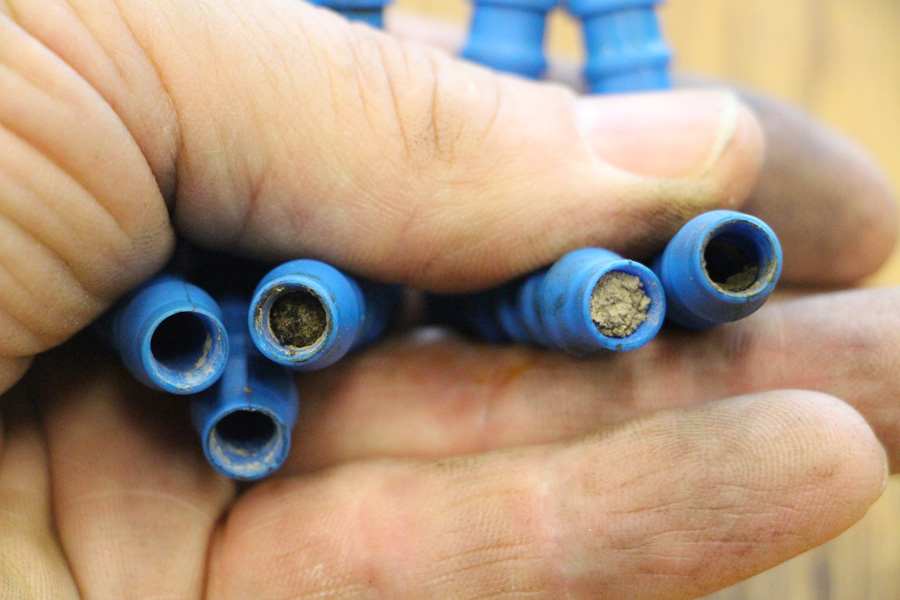
The vacuum caused fine particles to be distributed throughout the entire system. This in turn led to defects in the couplings, which then started to leak. A little carelessness when handling the vacuum lifting device led to relatively extensive damage.
Error found!
The consequences for use
- Due to the constricted system, some suction cups took a long time to suck in or release.
- With the vacuum supply line completely closed, the suction cup was pressed on and a vacuum was built up inside, which was not high enough for carrying, but much too high for releasing. Such a suction cup 388 with a closed vacuum connection can easily achieve a horizontal pull-off force of over 22 kg. And if you want to remove hanging appliances, it will rarely be done at the top and so the force will be fully effective when the appliance is moved horizontally. With the vacuum lifter with its 24 suction cups and approx. 50 % sealed suction cups, a holding force of over 250 kg is quickly achieved.
- All plug connections and valves can be damaged by the particles.
What have we learnt from this?
The vacuum lines must also always be checked. Ideally before each use, but at least every four weeks. If you have a vacuum lifter with individually lockable suction cups, this can be done quickly. Simply shut off all suction cups and then set the appliance to SUCTION. Now connect each suction cup individually to the vacuum system for a very short time. The warning signal for vacuum loss must then always be given immediately. This is actually a very quick method of testing. But first this fault must be recognised.
In the interests of safe operation of a vacuum lifter and your health, you should include such a test on a regular basis.