

The transported goods are usually a type of plate with a large surface area and a small thickness. In most cases, these are glass sheets, metal sheets or similar. A metal sheet that is only held in the centre will generally bend during transport, depending on the size of the surface and the thickness. This bending is usually unfavourable for subsequent storage or depositing, as it prevents precise positioning.
In addition, the bending forces acting on the suction cups cause a considerable additional load on the suction lips, which can lead to the suction cup detaching under certain circumstances.
The example on the following pages shows the effects of not keeping the transported goods stable.
Stable surface means that no deformation of the transported goods occurs
An example: A sheet of paper is to be transported horizontally (as if lying on a table) from A to B with a stable surface (i.e. without bending). In order to transport this piece of paper with a stable surface, you have to pick it up at many points distributed over the entire surface or it will bend.


Example of a non-area-stable transport
(because the transported goods themselves do not have sufficient surface stability)
In relation to the Kombi 7011-DS battery-powered device, this means
The 388 suction cups we use can hold approx. 300 kg on a clean glass plate until they are torn off, depending on the type of force applied and the speed, at a vacuum of 0.6 bar without taking a safety factor into account. In theory, a 7011-DS combi with 6 suction cups could hold approx. 1800 kg horizontally (without safety factor).
The frame dimensions are approx. 1.0 x 0.8 m. According to our specifications, materials with maximum dimensions of 2.0 x 1.8 m can be moved.
For example, take a steel plate measuring 3.0 x 2.0 m and weighing approx. 580 kg that you want to move horizontally.
You can then do this for approx. 10 seconds before the steel plate falls to the ground.
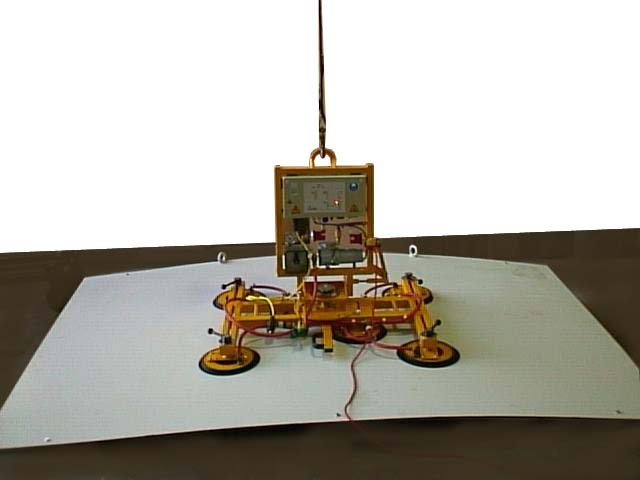
If you reinforce the steel plate with beams, transport is possible. Provided you can ensure that there is no deflection.
Stiffness is not quite as important when used vertically, as every sheet material has a certain inherent stability in this direction. Pick up the sheet of paper at one corner with two fingers and hold it vertically so that the 30 cm side is horizontal and the 20 cm side is vertical. The sheet hangs relatively straight, without bending.
If the inherent stability is too low, the bending of the material can lead to the same effect as in horizontal applications.
In relation to the Kombi 7011-DS battery-powered device, this means
The 388 suction cups we use hold approx. 200 kg on a clean glass plate until they slide off, depending on the type of force applied and the speed, at a negative pressure of 0.6 bar, without taking a safety factor into account. In theory, a 7011-DS combi with 6 suction cups could hold approx. 1200 kg horizontally (without safety factor).
The frame dimensions are approx. 1.0 x 0.8 m. According to our specifications, materials with maximum dimensions of 2.0 x 1.8 m can be moved.
For example, take a steel plate measuring 3.0 x 2.0 m and weighing approx. 580 kg that you want to move vertically.
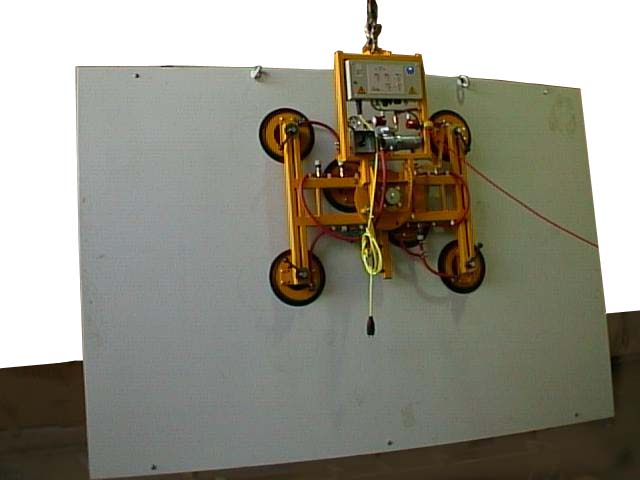
The steel plate is held, but the bending of the steel plate is already clearly recognisable. You are at the limit of what is possible.