

According to the Machinery Directive, all machinery and equipment made available to employees should have a CE mark and a declaration of conformity. This is the only way the employer can ensure that everything has been done correctly. In the event of an accident at work, insurance cover should be guaranteed and there should be no need to fear legal proceedings.
But simply relying on a CE mark is not enough. The contractor should look a little further to see whether everything is really plausible. If it is too obvious, every insurance company will try to at least seek a contribution to the costs from the contractor.
For this reason, we would like to give you some food for thought on what is worth paying attention to for the entrepreneur. Or you should at least take it into account in your considerations. Because everyone knows the saying: ignorance is no defence against punishment.
Pay attention to the correct CE mark

Anything else does not qualify as a CE mark.
The declaration of conformity is mandatory
According to the Machinery Directive, the two belong together. The following applies:
No declaration of conformity is valid without the CE mark.
No CE mark may be affixed in accordance with the Machinery Directive without a declaration of conformity.
Who is authorised to issue a declaration of conformity?
Only the European manufacturer itself or the importer who imports the device into the EU. It must be a European address that can be contacted in this way. A company from China or the USA cannot issue a valid declaration of conformity in accordance with the Machinery Directive.
So take a look at the declaration of conformity to avoid any nasty surprises. Only when everything is „good“, I would pay for the device.
The party issuing the declaration of conformity is responsible for the accuracy of the statements made.
Without a valid declaration of conformity, it cannot be assumed that the work equipment offers sufficient safety for the user.
What should be in the declaration of conformity?
The declaration of conformity should state the status of the Machinery Directive to which it refers. For example: in accordance with EC Machinery Directive 2006/42/EC, Annex II A
Otherwise, the standards taken into account should be listed.
EN 13155 is very important here for vacuum lifters and should definitely be included. We have already described what this means in detail in tip 12 „Minimum requirements for a vacuum lifter“.
For someone who wants to move single panes of glass using vacuum technology, compliance with EN 13035 Parts 1 and 2 should also be ensured. This is important if, for example, lifting systems other than a crane are used. Or so-called glass robots are used. This is because EN 13155 is normally only intended for „loose load handling attachments“. EN 13035 Parts 1 and 2 transfer this standard to such devices when transporting single glass.
What else needs to be considered?
The declaration of conformity presupposes that detailed operating instructions are available in the respective national language. Without corresponding operating instructions in the national language, the appliance is supplied incomplete and does not comply with the declaration of conformity.
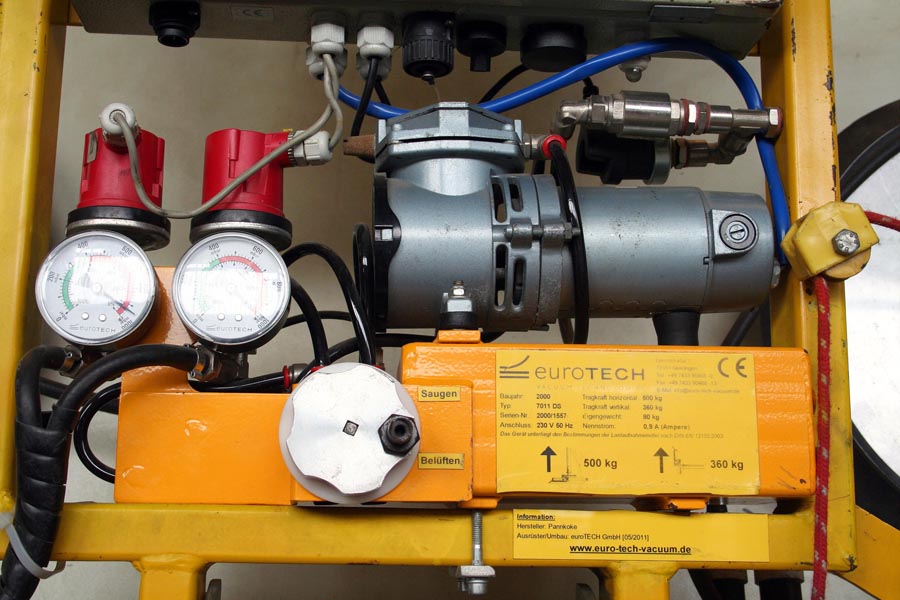
The appliance must have a type plate on which the manufacturer/importer and its full address are stated. The important technical data must also be available.
You should therefore find this information on the rating plate of a „loose load suspension device“:
- Company name with address
- Designation of the device
- Serial number
- Dead weight
- Year of construction
- Load capacity
What about buying used appliances?
The above also applies to these, and attention should also be paid to modifications. If the appliance no longer corresponds to its original condition, it has been modified. If it has been modified in terms of safety, the declaration of conformity and the CE mark affixed to it expire. The person who has made safety modifications to the appliance then becomes the manufacturer.
The important thing here is that the operating instructions must be available in the local language. Perhaps an example from practice. If the manufacturer originally sold the appliance to Denmark and supplied it with Danish instructions. He has done everything right. If this appliance is now sold to France by the original customer, then the original customer must now provide a French instruction manual. The manufacturer is not obliged to supply these French instructions. This may result in costs not previously taken into account.
Some things are not necessarily immediately obvious to the layman. Replacing the suction cups, for example, is a change to the vacuum lifter for safety reasons. This is because suction cups, despite their similar design, sometimes have considerable differences in load capacity. To avoid falling into a trap, the manufacturer's suction cups should always be used.
On our YouTube channel you will find numerous tensile tests with different suction cups on this topic. Some of these differences are in the range of 25 %. If the original can carry 200 kg vertically and the replica can only carry 150 kg, this is a significant interference with the safety of the vacuum lifter. You should always bear this in mind.
If you want to buy a used vacuum lifter, pay attention to the age of the suction cups. We, as well as Woods, recommend replacing the suction cups every 24 months to ensure sufficient load capacity.
Look out for changes to the load-bearing parts. Subsequently welded lifting eyes or similar have probably not been fitted by the manufacturer. Cracks on the weld seams indicate previous damage.
If you keep this in mind, buying a used vacuum lifter can pay off. If you don't, it can be very expensive to get such a vacuum lifter back into working order.
Caution trap - converted device
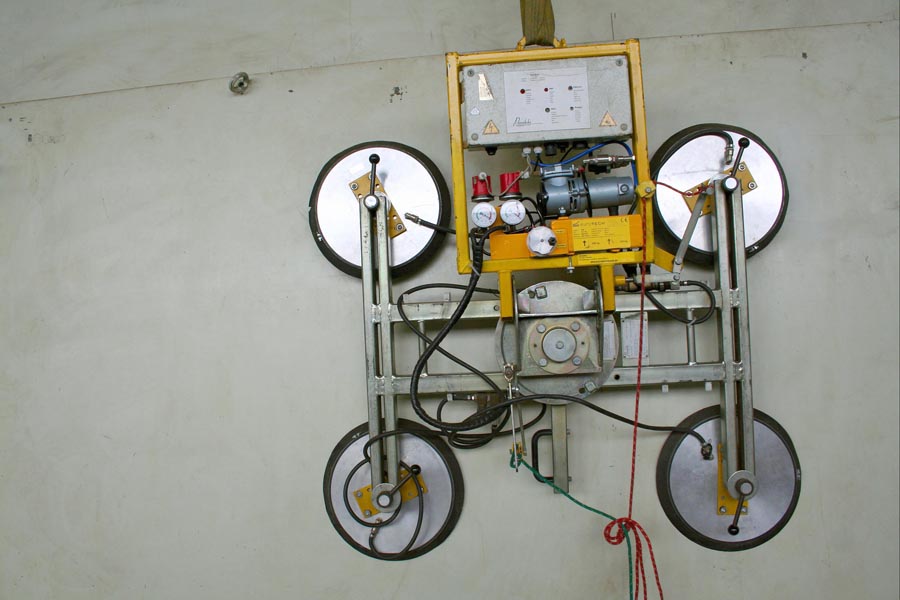
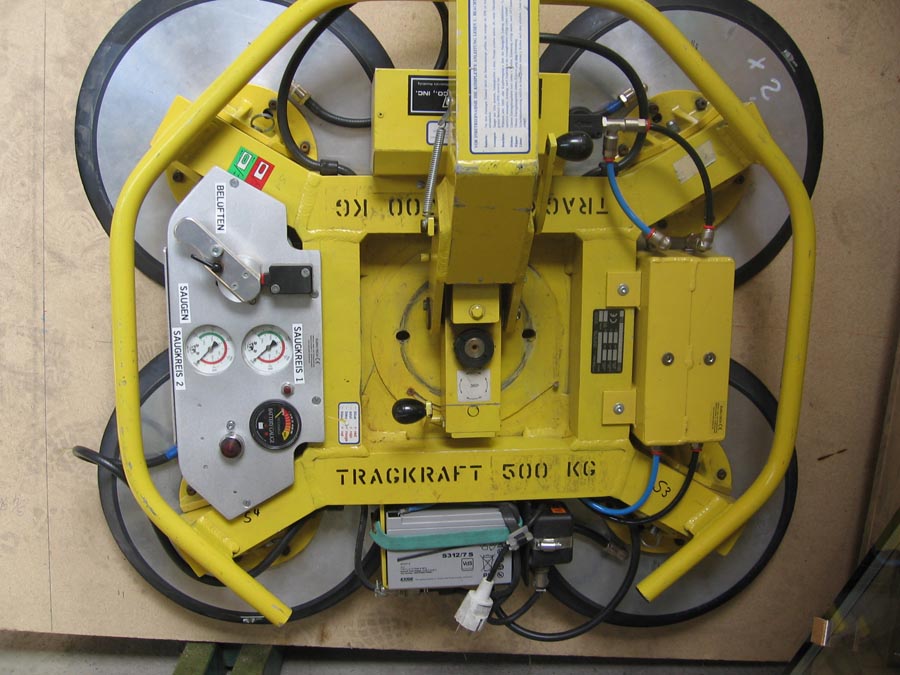
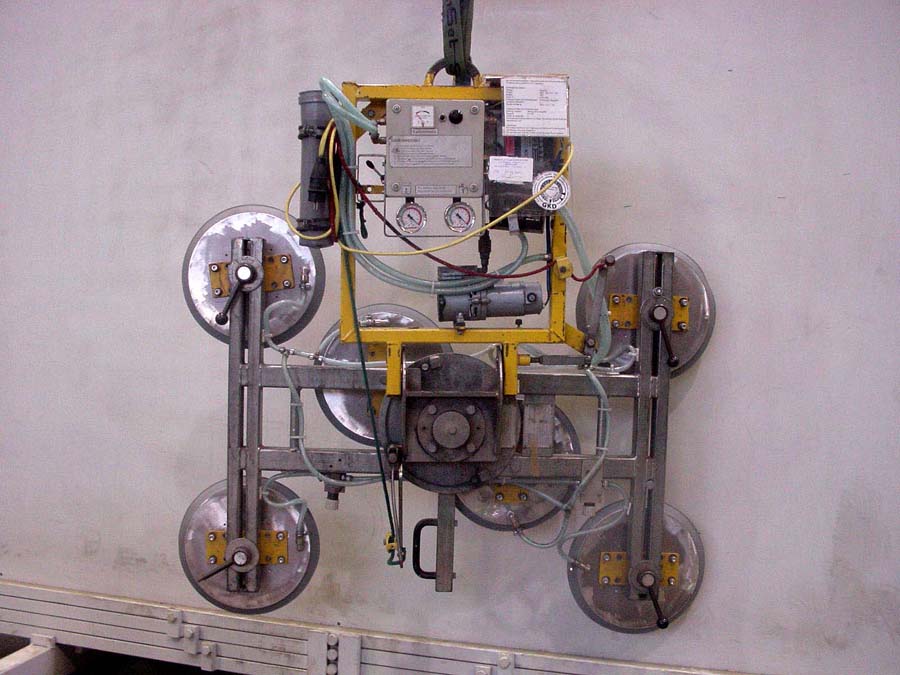
There are still many 1-circuit vacuum lifters that have been converted into 2-circuit vacuum lifters by some company or other. Special care should be taken with such devices. This is most likely a safety-related modification. This means that the original manufacturer of the single-circuit vacuum lifter is no longer responsible for the device and is no longer a manufacturer of it. The person who converted the appliance then becomes the manufacturer of the appliance and places it on the market again at the time of the conversion. He must then remove the old type plate and replace it with a new type plate of his own. In addition, he must then supply operating instructions and an EU declaration of conformity for the „newly created appliance“ in the language of the user to whom the appliance was sold.
If you wish to have an inspection/maintenance carried out by the original manufacturer, they will usually refuse to do so. You should also consider this in advance before making such a purchase.
Here are some practical examples where you should be very careful.
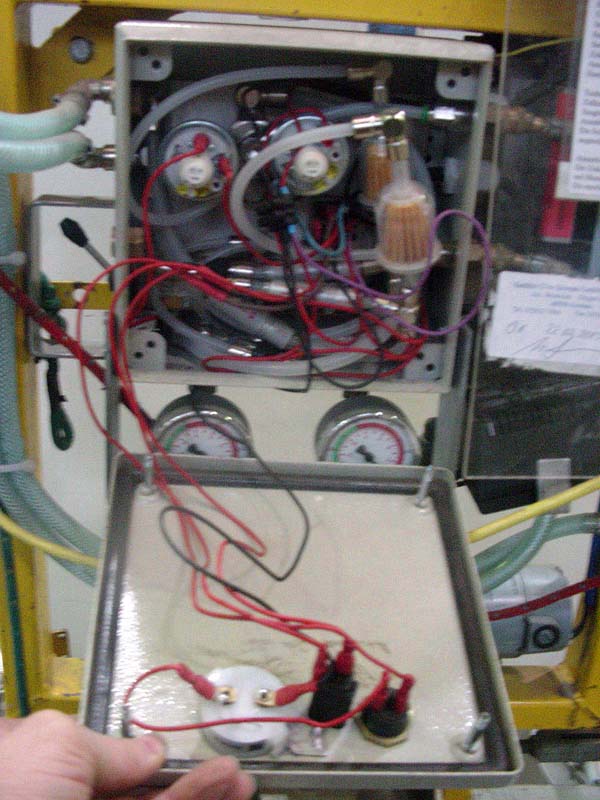
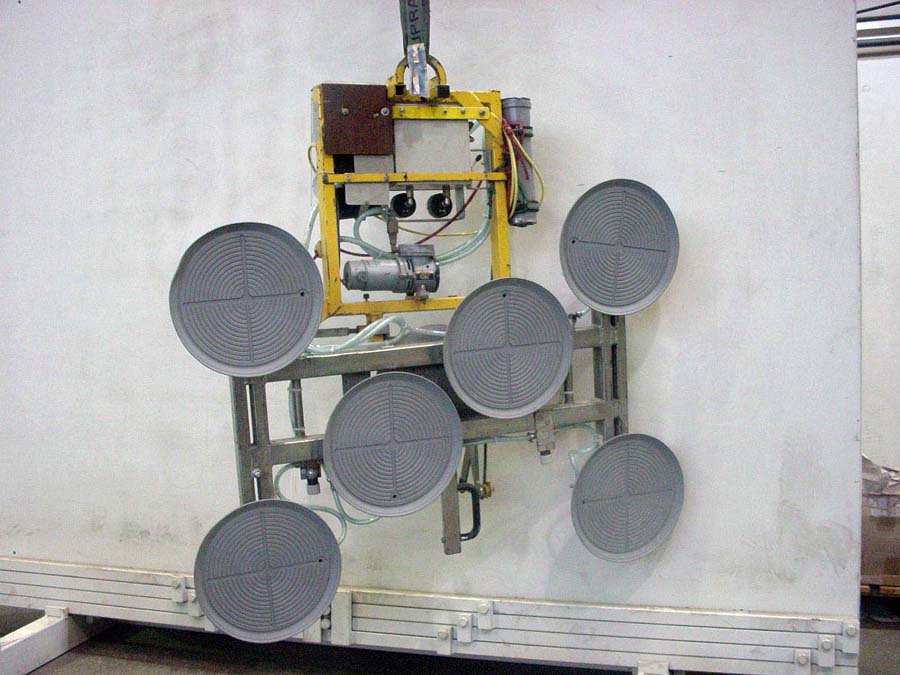
Self-builds - you should think about this
We've often seen our own constructions during our maintenance work. If you make something like this for your own use, you should always remember that a declaration of conformity, a type plate, a CE mark and operating instructions are also required. Many people are unaware of this or suppress it. However, it is also listed in the Machinery Directive and should always be observed. If not, the person responsible who has provided this to their employees will be in a lot of trouble if an accident occurs. It is better to avoid this in advance.
We hope that this information has helped you to avoid investing your hard-earned money in vain.