

Do you also use a vacuum pump in the crane runway in your glass store, which supplies a suction cup support frame with vacuum via a hose reel?
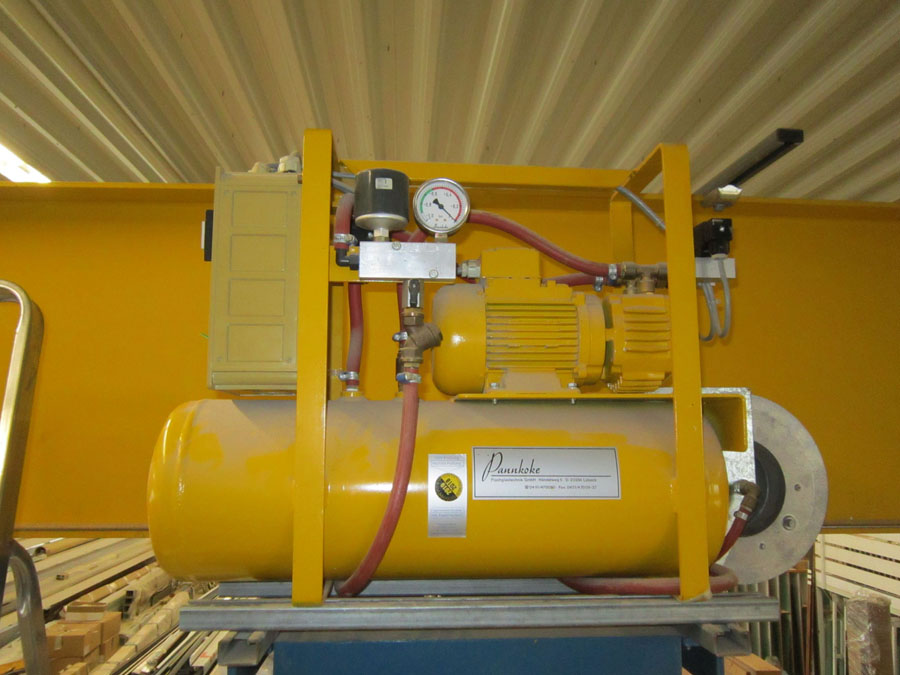
Compound pump
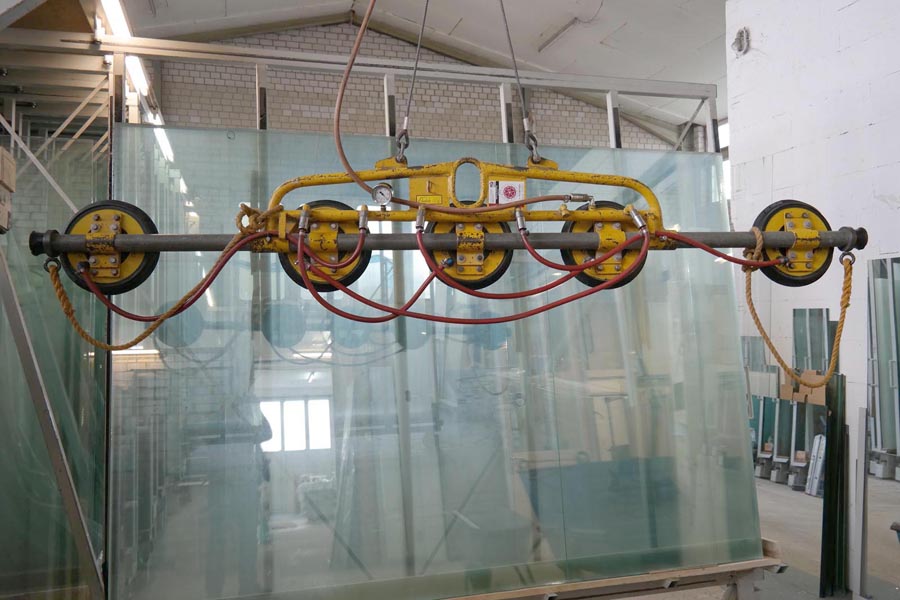
Then you should think about the existing risk. Even if you have been using this type of application for years and have never had any problems, there is a high risk of serious injury. This is not theoretical, it has already happened. The worst case we know of resulted in the employee being off work for 9 months. The shoulder area was cut open by a shard of glass, severing tendons and ligaments. Therefore, if a hose reel is still being used according to your risk assessment, it should be checked thoroughly at least every month. If such a serious accident happens to you, you will be able to prove that you have recognised the weak point and checked it regularly. This is better than „ignoring“ the risk you are now aware of.
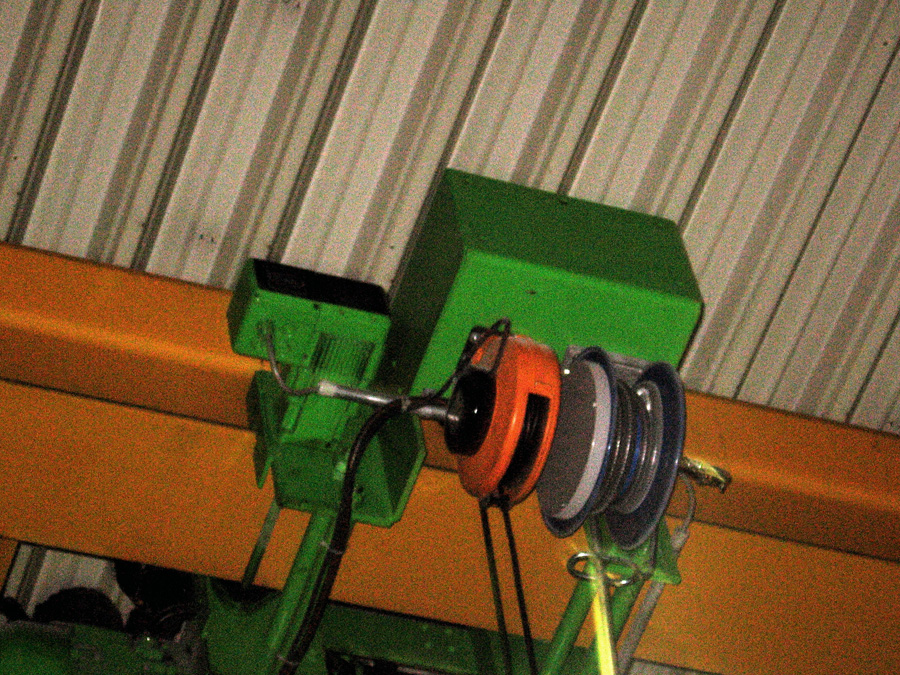
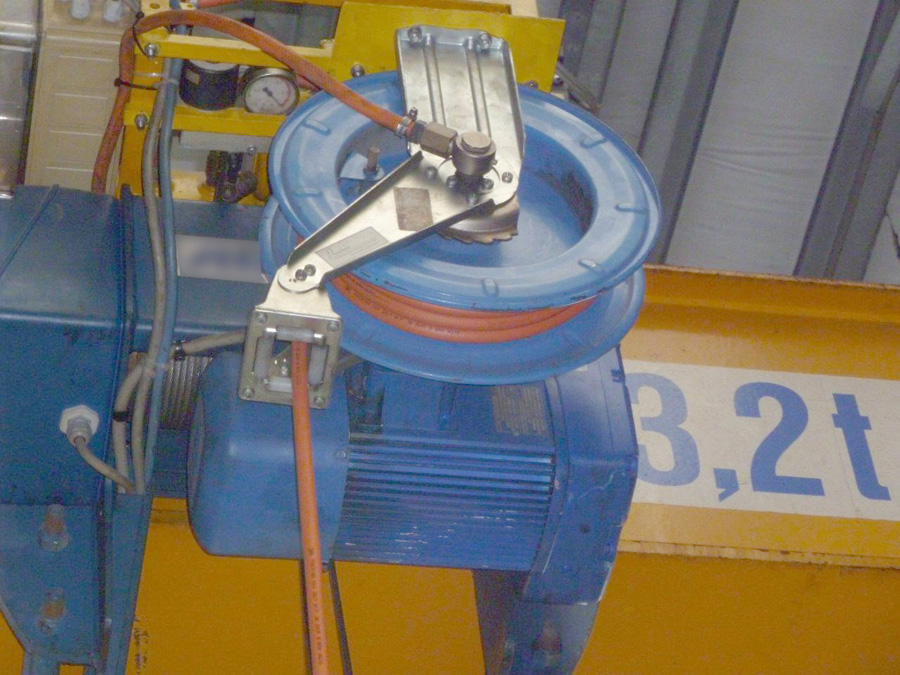
Weak point of the hose reel
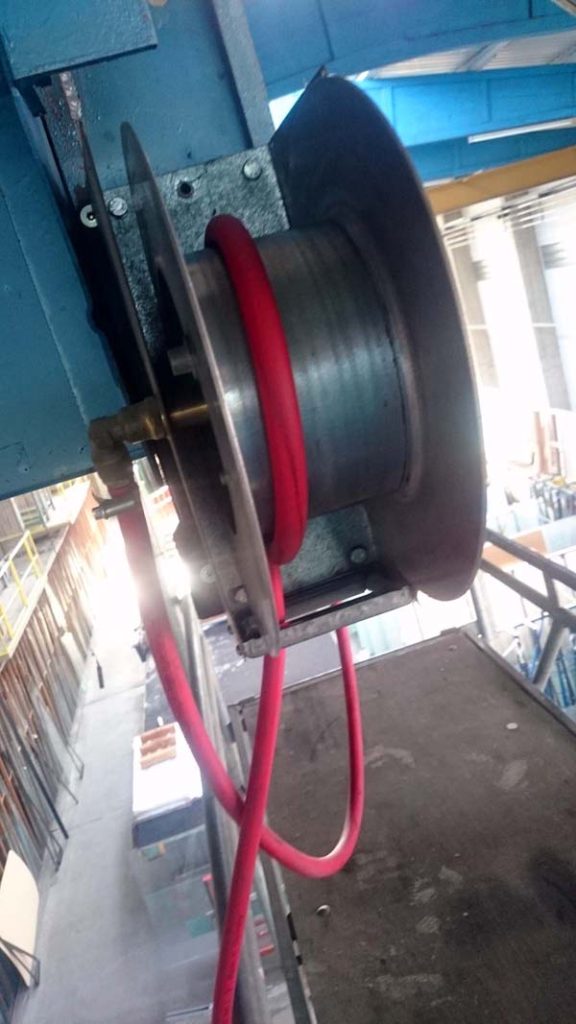
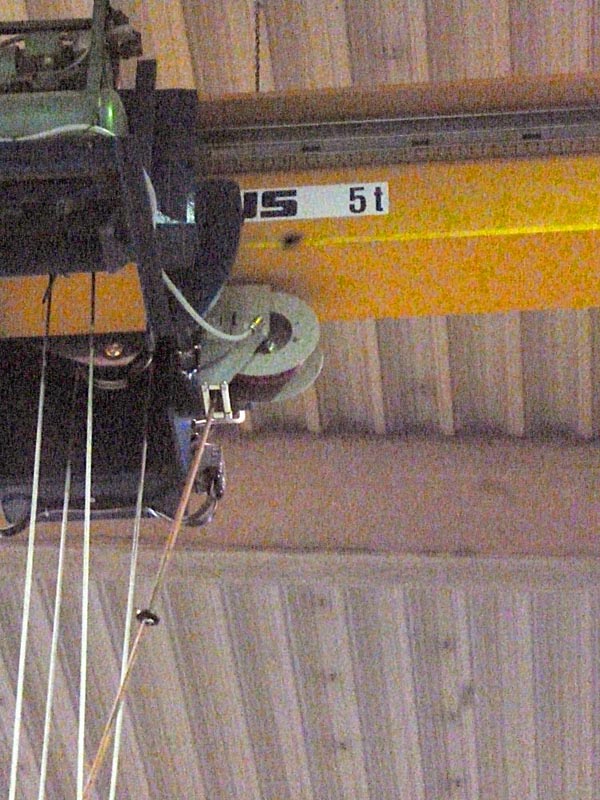
The main weak point of the hose reel is the rotating axle and its seal. Anyone who believes that a leak extends over the entire area is completely wrong. There is usually a leak in just a small section, but this can lead to the hose being severed and the vacuum being lost completely and suddenly. I don't need to tell you in detail what this means. This section may be less than 1 cm long of the entire tube. Everything is fine before and after, but if you transport the glass pane at exactly this height, the glass pane falls down and you no longer have a chance to react. This is what makes it so dangerous.
The main weak point of the hose reel is the rotating axle and its seal. Anyone who believes that a leak extends over the entire area is completely wrong. There is usually a leak in just a small section, but this can lead to the hose being severed and the vacuum being lost completely and suddenly. I don't need to tell you in detail what this means. This section may be less than 1 cm long of the entire tube. Everything is fine before and after, but if you transport the glass pane at exactly this height, the glass pane falls down and you no longer have a chance to react. This is what makes it so dangerous: the main weak point of the hose reel is the rotating axle and its seal. Anyone who believes that a leak extends over the entire area is completely wrong. There is usually a leak in just a small section, but this can lead to the hose being severed and the vacuum being lost completely and suddenly. I don't need to tell you in detail what this means. This section may be less than 1 cm long of the entire tube. Everything is fine before and after, but if you transport the glass pane at exactly this height, the glass pane falls down and you no longer have a chance to react. This is what makes it so dangerous.
But how can such a hose reel be tested?
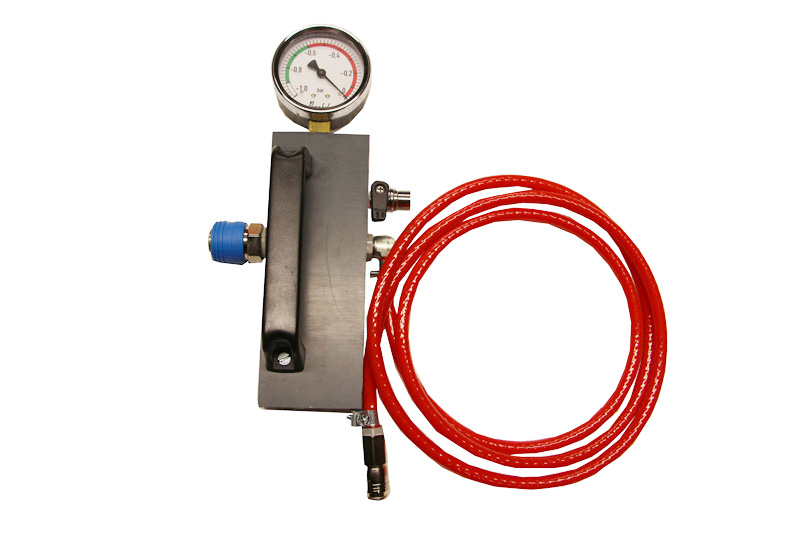
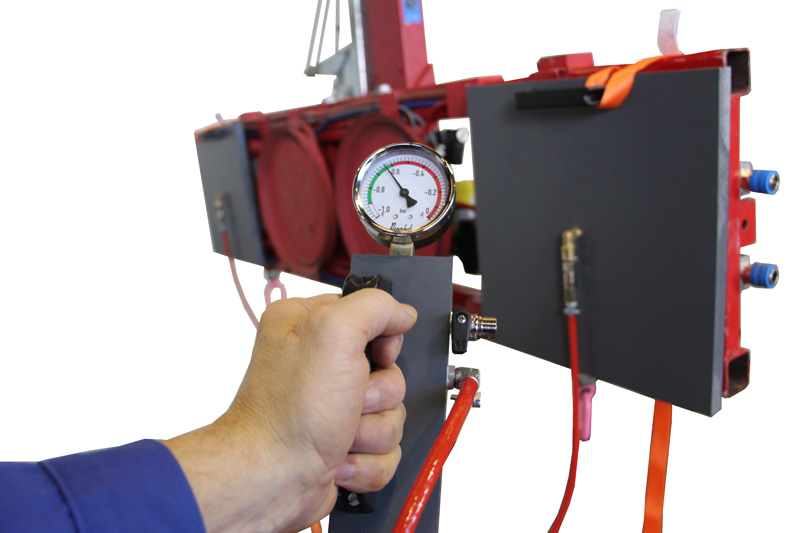
Like almost everything, it's quite simple if you know „how“. You need a few metres of hose with a control vacuum gauge. At the other end is the counterpart to the coupling of the hose reel. Another advantage would be a ventilation valve to check the warning signal. The hose is then wound and unwound very, very slowly and the vacuum gauge is monitored. If the vacuum drops, even at just one point, the seals or the entire hose reel should be replaced immediately. It is very important to move very slowly during this test, otherwise the faulty area can quickly be skipped and you will not recognise the defect.
With our test set, not only can the hose reel be tested, but also the warning signal and, in the case of a cordless vacuum lifter or appliances with switch-off technology, the 2-point control can be tested and set if the suction cup test plate is included.
To test the hose reel, you can hold the vacuum gauge comfortably in one hand and slowly move the hose up and down with the other.
And what else speaks against the continued use of this solution?
According to EU standard EN 13155, since 1 January 2004 every vacuum lifter should have a control vacuum gauge with labelling of the danger and working area. There must also be an optical or acoustic warning device.
Now many people say, „I have so-called grandfathering for my old appliances“. But unfortunately we have to disagree with this, because the Ordinance on Industrial Safety and Health of 1 June 2015 abolished this so-called grandfathering once and for all. Everything must now be brought up to the state of the art. And the state of the art is defined by the standards, among other things, and this closes the cycle again. „It's not all that bad“, you might say, but if a serious accident like the one mentioned above occurs, every insurance company will try to ensure that they are not left with the costs. It's bad if the employer/safety officer or whoever is responsible is proven to have been negligent. With this in mind, you should reconsider the risk assessment of such a solution and bear in mind the possible consequences. As the saying goes, „ignorance is no defence“.
So each of these solutions should now have a corresponding warning device. But beware, this must also function in the event of a power failure.
In 2004, we decided that this would be difficult to solve with a vacuum pump in the crane runway and did not pursue this concept any further. In addition, the issue with the hose reel has not been resolved and the risk potential is too high in our eyes. Especially as accidents of this kind are known.
Our advice
- Upgrade your equipment fleet.
- Only use complete vacuum lifters on the crane hook.
- Do not use long vacuum hose lines.
And until you have done this, check your hose reel. It doesn't matter whether you use our test kit or something you make yourself, but be conscientious when testing it. It's about your safety and that of others around you.
Just in case, think about why you are using it this way. Keep a written record of your considerations, because we can advise you against „carrying on like this“. In our opinion, the solution with separate vacuum generation, connecting hose and support frame with suction cups is far too dangerous to continue using.