

How should a plug-in coupling be maintained?
Plug-in couplings are often used to connect suction cups to vacuum lifters. To keep them in good condition, the couplings should be briefly sprayed with a spray oil, for example W40, and then the couplings should be blown out with clean compressed air.
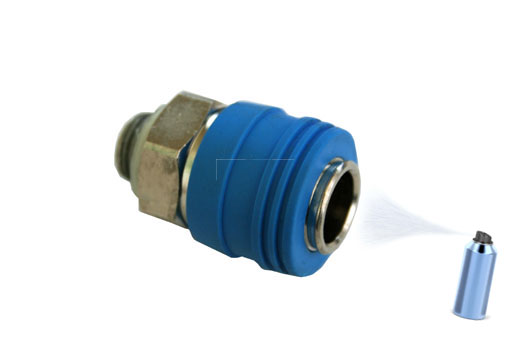
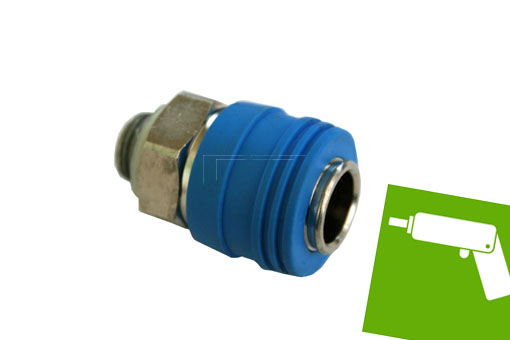
This keeps the mechanism running smoothly and the clutch closes better. It also removes the dirt in the clutch. It is only important that the clutch is not completely sealed when blowing out so that the dirt on the clutch can escape and not get inside the appliance.
How can a leaking clutch be detected?
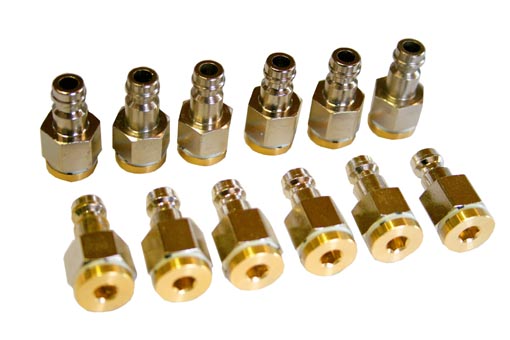
It often happens that an unused plug-in coupling does not close properly, resulting in a leak in the vacuum lifter. As no air escapes, but only flows in, these leaks are not easy to find.
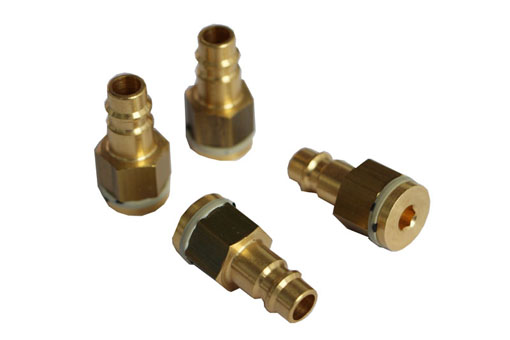
Our test set, which consists of plug-in nipples with caps, helps here. In other words, an absolutely tight plug-in nipple. This usually seals such defective couplings. This requires as many Bind plug-in nipples as the vacuum lifter has couplings. The connection hoses are removed from all couplings and replaced with the blind plug-in nipples. The leak test is then carried out. If the vacuum system is now leak-proof, each blind plug-in nipple is removed in turn and the leak test is carried out. This allows the leaking couplings to be located quickly.
If the attempt with the spray oil and blowing out is unsuccessful, replacing the plug-in coupling is the quickest way to rectify the fault.
Another option is to insert the blind plug-in nipple into the coupling. This is because it can usually be used to seal the plug-in coupling.
How can a plug-in coupling be protected against soiling?
The best protection is to insert such a blind plug nipple into a plug-in coupling that is not in use. This prevents dirt from entering the coupling and getting into the valve seat the next time the connection hose is plugged in.