

Ageing of vacuum cups
As already mentioned in previous tips, vacuum cups age over time and therefore lose their vertical load-bearing capacity. The coefficient of friction decreases over time, reducing their load-bearing capacity. This can be more than half of the load capacity. Regular cleaning of the suction cups will improve this, but it cannot be avoided.
A new suction cup therefore generally has a better load-bearing capacity than an old suction cup. And this can lead to problems that nobody wants. The one suction cup that you have replaced, perhaps because it had a torn suction lip, will hold up better than the other suction cups. No big deal, or what do you think?
Here is an example of a vacuum lifter with four vacuum cups. The suction cup circled in red has been replaced. The other suction cups are older and already have a lower load capacity.
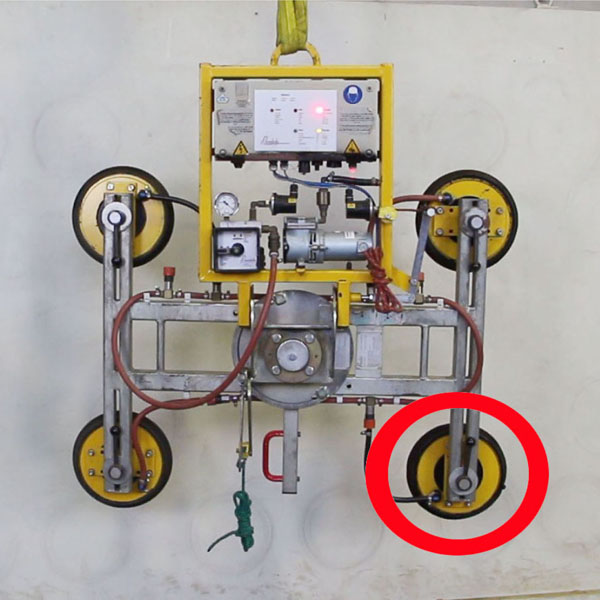
What could happen? Can anything happen at all?
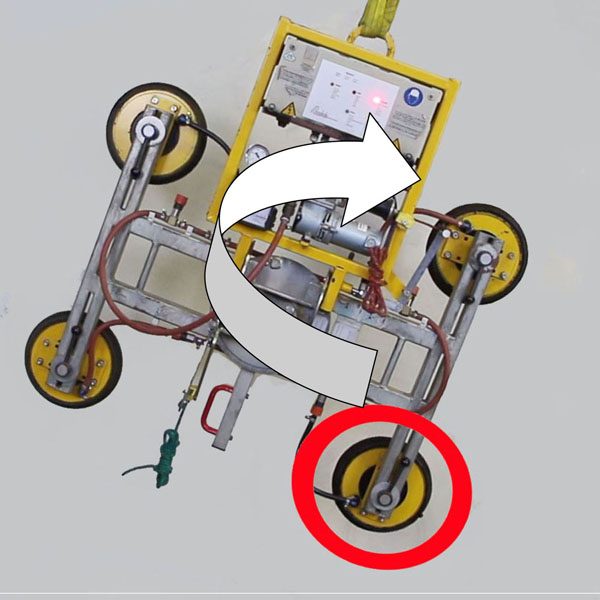
The new suction cup will try to hold everything that is placed on it. If the other suction cups have a lower load capacity, the new suction cup will be loaded more. This could result in the appliance rotating around this new suction cup under load because the other suction cups are already starting to slip. This does not always have to be as extreme as shown in the following photo. But every time the other suction cups slide, the new suction cup is subjected to more load. This could result in the new suction cup being overloaded, which would lead to the suction cup coming off and the transported goods falling down. This will certainly not play a role with lower loads, but it can lead to such problems in the nominal load range.
If you really want to rely on the vacuum lifting device and work with sufficient safety, you should always replace all suction cups if they are older than six months.
The suspension point always wants to hang vertically below the load point, which causes the suction cup frame to rotate. This improper use of the device can result in damage to the vacuum lifting device. As a rule, vacuum lifting devices are not designed for such loads.
We have also documented this situation in a short video. Although the vacuum lifter does not twist as much as shown in the photo, the tendency is clearly recognisable.
Find it on YouTube:
Why can replacing a single suction cup be dangerous?
Incidentally, this can also happen if you use suction cups from different manufacturers on the vacuum lifting device. Therefore, only ever use vacuum cups from the manufacturer of the vacuum device. In this way, you avoid such unforeseen cases and the responsibility for the device remains with the manufacturer and not suddenly with you.
Here you can also look at individual tests with teats of different ages. Perhaps you will then understand why it is so important for your safety and that of others to replace the teats from time to time.
Find it on YouTube:
Tensile test with a new suction cup 388
Find it on YouTube:
Tensile test with a suction cup 388 that is 5 years old
Find it on YouTube:
Tensile test with a suction cup 388 that is 10 years old
Here you can also look at individual tests with different, new, unused suction cups, perhaps you will then understand why it is so important for Your safety and the safety of others is so important to use only the original suction cups.
Find it on YouTube:
Tensile test with a new suction cup 388
Find it on YouTube:
Tensile test with a suction cup 388-4N/TR that is 6 months old
Find it on YouTube:
Tensile test with a new Eurotech suction cup BLSP.280.111.001
Find it on YouTube:
Tensile test with a Eurotech suction cup BLSP.280.111.016, which is 10 months old
Find it on YouTube:
Tensile test with a new Eurotech suction cup BLSP.200.111.007
Find it on YouTube:
Tensile test with a new Eurotech suction cup BLSP.200.111.012
Find it on YouTube:
Tensile test with a new Wood's PowrGrip suction cup G3370